Showing posts with label Coverage of an event. Show all posts

Tuesday, June 24, 2014

The goodbye to one of ours

Today we show again pages from Diario de Burgos. We thought it approached in an excellent way the death of one of its more distinguished "sons", the master Rafael Frühbeck from Burgos. 

Tuesday, March 11, 2014

10 years since the 11M

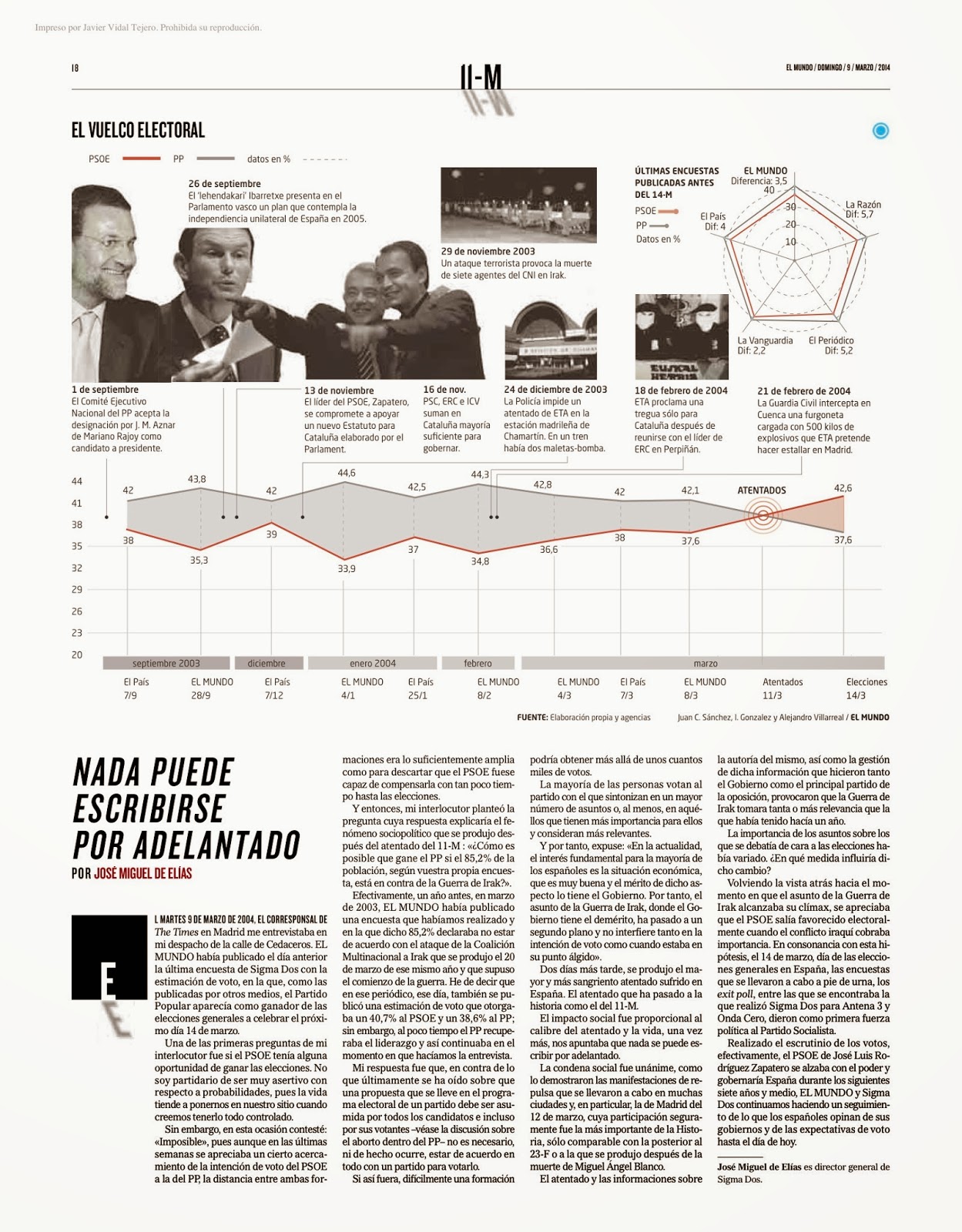
Today is the 10th anniversary of the biggest terrorist attack Spain has ever suffered. The anniversary has provided plenty of pages these days. We are going to offer a selection. We begin with the supplement V, that on Sunday the 2nd of March was entirely dedicated to the event:

 The Sunday´s supplement from El Periódico also focused on the 11M:


In El País we saw an excellent interactive infographics:


The biggest display was made by El Mundo , which published a 48 page report:

Friday, March 7, 2014

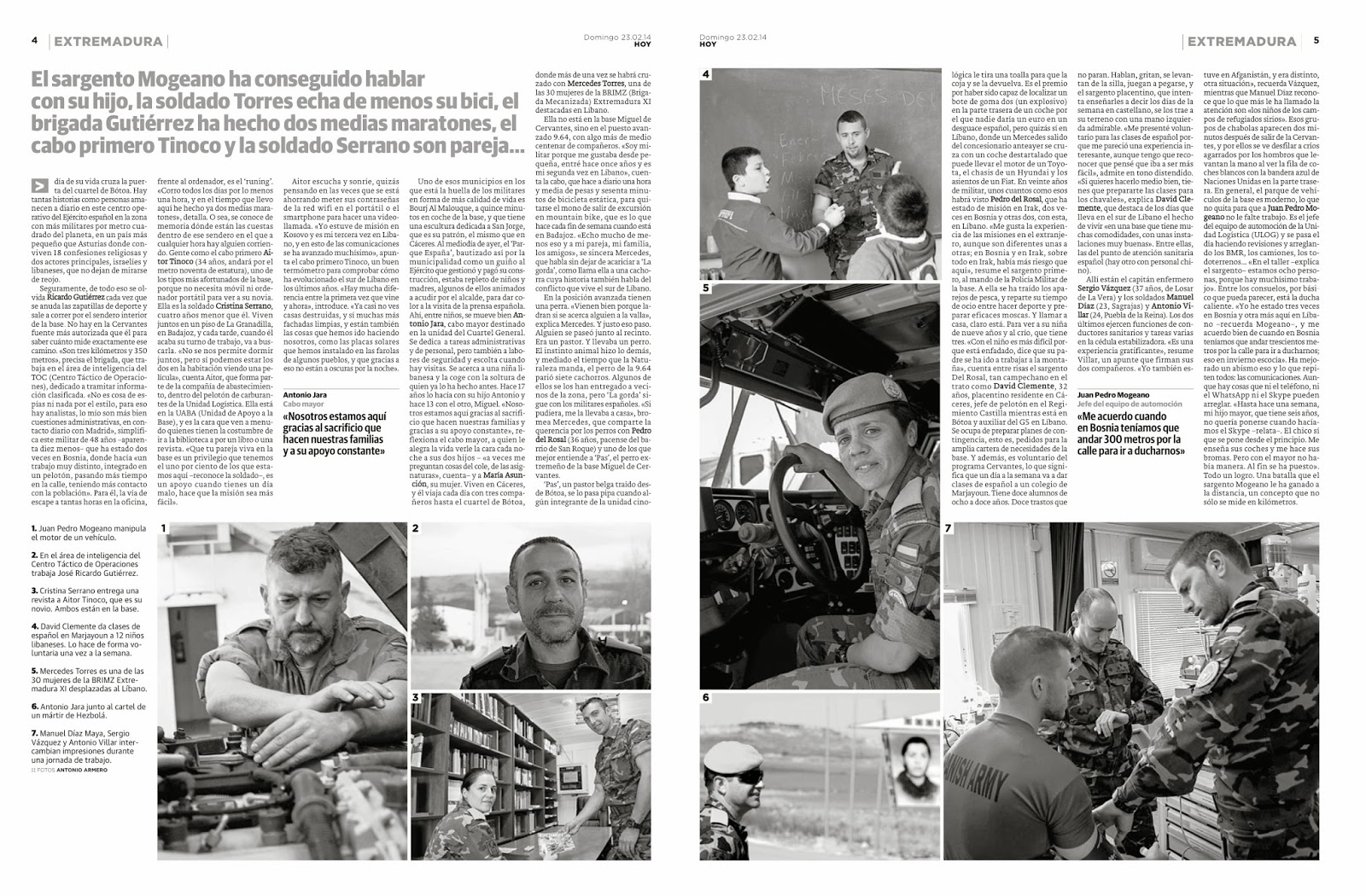
Extremaduran lives in Lebanon

Antonio Armero, a journalist from Hoy (Badajoz) writes: " In the military headquarters Miguel de Cervantes´  in Marjayoun (Lebanon) there is a report to be found on every corner. The working premise has been to attempt to show how the 425 army members from the Mechanized Brigade Extremadura XI live there, as they are usually based in Bótoa (Badajoz) but are in Lebanon since the middle of November and will come back between the 15th and 24th of May. The idea is to explain at what time they wake up, what they eat, how they relate amongst themselves, what kind of work they do and in which context it develops and up to what point they assume risky situations, etc."

“If you understand what is happening in Lebanon then it is because you know nothing about the country. Nico Lupo, a Catalonian freelance journalist who has been living in Beirut for 2 years, told me that this is a sentence sometimes used by journalists in the area to summarize the reality they are trying to explain on a daily basis. It is a complex situation we try to summarize —too much, really— in the first report titled “425 Extremadurians guard the blue line”. It is written with the idea of situating the reader without going into more depth. From that point onwards, the following pieces have tried to meetthe challenge of telling how those who pass their days in the headquarter Cervantes live.”

“At the same time, on the website we have been publishing photo albums about the life at the headquarters, as a complement to a blog (7 days in Lebanon) with an informal tone, conceived as a space to collect details about exactly that: daily life.  And, finally, next to the blog we set up a window that gathered what we were saying through Twitter, including the reactions, mostly signed by the military personnel’s families. A work that occupied the day from the beginning to the end and that has been, personally and professionally, as intense as it has been interesting.”

A newspaper, small as it may be also travels up to where “its people” live. Even though “its people” are more than 3000 kilometers away. This is the coverage, with a sadly unexpected ending, of those days in Lebanon. 

Monday, February 10, 2014

Tragedy in Ceuta

The work done by small editorial departments is always admirable, but even more when something unexpected and very relevant happens. El Faro de Ceuta experienced one of those situations last week: nine people —the number would increase up to 14 people later— died trying to reach Spain from Morocco. This was their coverage:

Tuesday, November 12, 2013

Appointment with the President

Just like yesterday, today we offer another well-designed, excellent idea. El Periódico covered a meeting between the President of Europe´s Parliament  and ten young people.

Monday, October 7, 2013

Al Día from Costa Rica

It´s not the first time we show examples from the sports newspaper Al Día. We want to point out two events.
The first one is the behind-the-scenes article prior to the soccer match between Costa Rica and the U.S. “In the front-page —they tell us— we used the famous role of uncle Sam, we put the face of a player from Costa Rica´s team and with the title “tiemblen” (“be afraid”) we wanted to show a challenging feeling”. In the next behind-the-scenes article “we used graphics montage from Landon Donovan, the player who commands the US team. He is known as Captain America. We used that information to make a comic style, front-page. The idea was that our team had to stop Donovan”.


Another event was a “classic” soccer match between two local teams. “During the week we ran out of pictures from our files to talk about the match so we used an illustration which represents the fight over the ball. Saprissa and Alajulense are two teams which have always been rivals. The match between them is called “the classic” in Costa Rica — similar to any match between Barcelona and Real Madrid in Spain—. In the inside pages we elaborated an infographics with statistical facts from both teams.
The day after, the coach assistants from the national team gave a report about the performance of some players during the match”.


Monday, September 30, 2013

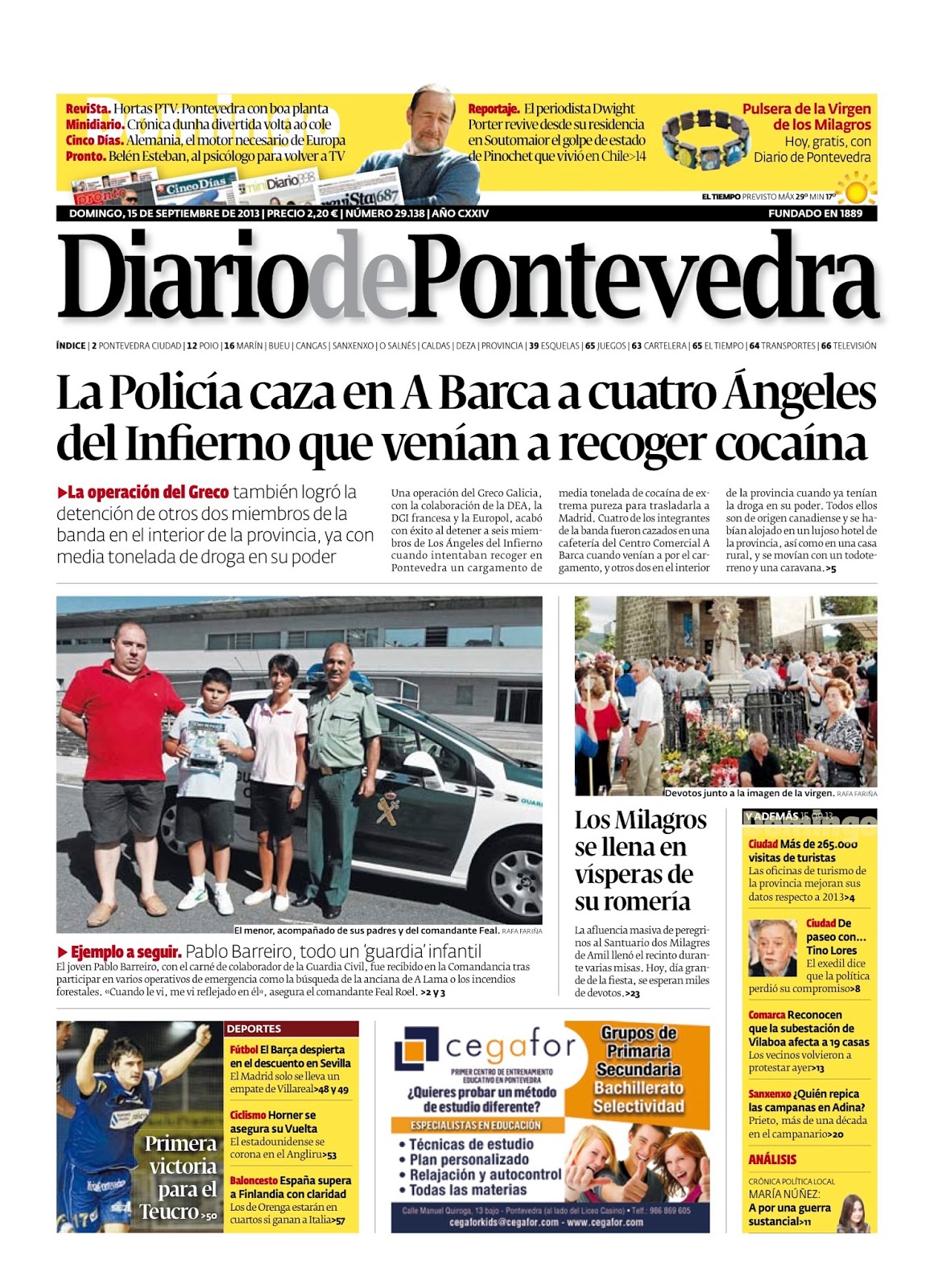
Rafa Fariña, photographer

Today´s post focuses on how Diario de Pontevedra covered a fire that happened late at night. We have paid attention to everything, but especially to the role of its photographer, Rafa Fariña. To know why, it is not enough to look at his pictures; we must read what his colleague Adrián Rodríguez has told us.

“We were told about the fire after 9 pm. Our closing hour is 12 pm, so we needed to act quickly: we had to make space in pages that were almost finished and to assess the importance of what was happening. We kept in permanent touch with the photographer who was already on his way home and had to go to Ponte Caldelas,  20km from Pontevedra. At the beginning we were not going to give much importance to the story but at the end we gave it a double-page. The photographer, Rafa Fariña, told us the topic was important and that there would be good pictures, so it was fundamental to use them.  That is why we did such a graphic double-page. There was another factor to bear in mind: some houses had been affected and the neighbors fight against the fire had altered the course of it. That meant that even though houses were going to be saved, dozens of hectares were going to burn throughout the night and it was useless to give any number as it was going to be out-dated. This is the result of three hours of work”:
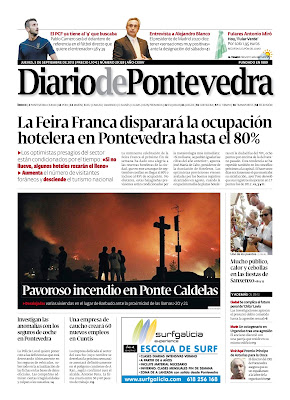
"The photograph´s work didn´t end there. He uploaded the pictures into our system with his iPad and he stayed up in the mountain until 5 a.m. The work was still going to be difficult the next day, so we had to call in the cavalry. Águeda Piñeiro, the correspondent in that area was on vacation and wasn´t coming back until two days after. But we called her and asked for the possibility of coming back earlier. She had no obligation to do it but she accepted and the next morning she went with the photographer and looked for the eye-witness accounts of those who had been fighting the fire. We also needed to use those great pictures we already had".

"Once the fire was under control, it was time to find an explanation for what had happened, something that generates a lot of debate in Galicia. We did not want to get enmeshed in the political debate, so we turn to those who best know the mountain. We asked Xan Sabarís´ team to make an infographic report that could help understand the size of the burned area".


"There was still time for the flames to revive and for the photographer Rafa Rariña to show us how it is worth having an experienced professional on your team".


"Víctor Méndez, our specialized editor in events, got a beautiful ending for the story: an anonymous hero (not so anonymous now) that studies 6th grade at Elementary School".